
Rocket Store: Headless Commerce for Doublepuc × Mor Bakery
A headless Shopify storefront with live bidirectional Rocket OS integration — eliminating manual phone orders for Mor Bakery, with a Medusa-powered custom commerce platform in the pipeline.
Client
Doublepuc × Mor Bakery
Year
2025
Services
E-commerce, Design & Development, Hospitality
Website
Visit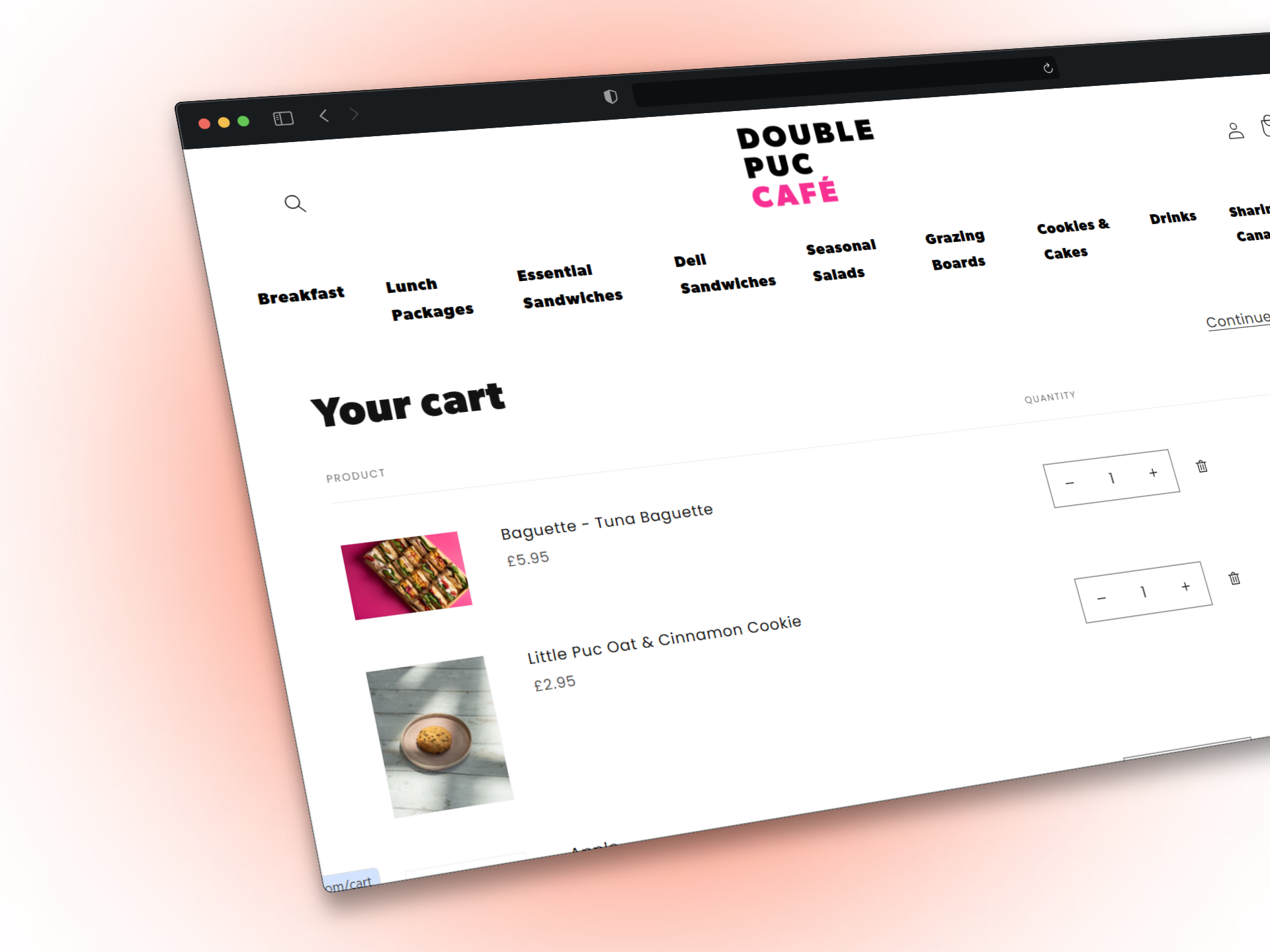
Doublepuc came to us with a deceptively simple brief: replace the phone. Mor Bakery — their food-production client — was processing a significant volume of wholesale and retail orders entirely over the phone. Staff were transcribing requests by hand, cross-referencing stock, manually keying orders into Rocket OS, and chasing confirmations. It worked, but it was fragile, slow, and impossible to scale.
Headless from the start
The decision to go headless rather than off-the-shelf Shopify was deliberate. A standard Shopify theme would have forced the storefront into Shopify's visual and structural constraints — fine for a generic DTC brand, not right for a business with complex wholesale pricing, bespoke delivery slots, and deep integration requirements with a proprietary ERP system.
Instead, we built a fully custom Next.js storefront powered by the Shopify Storefront API. This gave us complete design freedom and allowed us to build the exact checkout flows, customer account experience, and product browsing logic that Mor Bakery's customers — a mix of wholesale trade accounts and retail buyers — actually needed.
The integration layer
The storefront alone wasn't enough. The real engineering challenge was keeping Shopify and Rocket OS — Doublepuc's own bakery management platform — in perfect sync without any manual intervention.
We engineered a bidirectional integration that runs continuously in the background:
Rocket OS → Shopify: product catalogues, customer records, delivery locations, and pricing tiers are pushed automatically. When availability changes in Rocket OS, the storefront reflects it in real time. There is no manual product management step.
Shopify → Rocket OS: every order placed online is immediately written back to Rocket OS as a production order. The fulfilment team sees it the moment it's placed — no re-entry, no delay, no dropped orders.

Live at store.doublepuc.com
The Doublepuc storefront launched in 2025 and is live at store.doublepuc.com, processing real orders today. Phone-through orders have been eliminated for the customers using the platform. The bakery team reclaimed hours of daily admin, order accuracy improved substantially, and Doublepuc now has a repeatable commerce infrastructure they can deploy for other food production clients on the Rocket OS platform.
What comes next: Mor Bakery on Medusa
The Shopify headless approach solved the immediate problem — but it has a ceiling. Shopify's checkout is powerful, but it's still Shopify's checkout. For Mor Bakery's next phase, the requirements have grown: fully custom wholesale pricing tiers, configurable product bundles and packaging options, bespoke checkout flows with delivery-window booking, and deeper control over shipping logic than any hosted platform allows.
For this, we're evaluating Medusa Commerce — an open-source, API-first commerce engine built for exactly this kind of complexity. Unlike Shopify, Medusa gives us full ownership of the commerce logic: we can write custom pricing modules, build multi-warehouse fulfilment rules, and create checkout flows that feel like product features rather than workarounds. Nothing is locked behind a third-party API.
It's a more ambitious build, but it's the right foundation for a food business with real operational complexity — one that needs its commerce infrastructure to behave like a custom product, not a hosted service.
From the journal

AI & Technology · 17 April 2026
Everyone's Building Tools With Claude. The Hard Part Is Shipping Them.

Development · 17 April 2026
Umbraco vs WordPress: Why Serious Businesses Are Making the Switch
AI & Technology · 17 April 2026
Umbraco 17 Is Here — And It Changes How You Work
What we do
Headless.
Commerce.
Integration.
We build headless commerce storefronts and the integration infrastructure behind them — connecting front-end experience to back-end operations without compromise.