
Octoplan - Internal Workflows
Octoplan replaced Resource Guru, Everhour, Asana, holiday management, and invoicing with a single AI-powered platform — built in three weeks using Claude Code. Dictation-based ticket creation, intelligent forecasting, custom client access, and deep migration from existing systems.
Client
Octopus (Internal)
Year
2026
Services
SaaS, AI
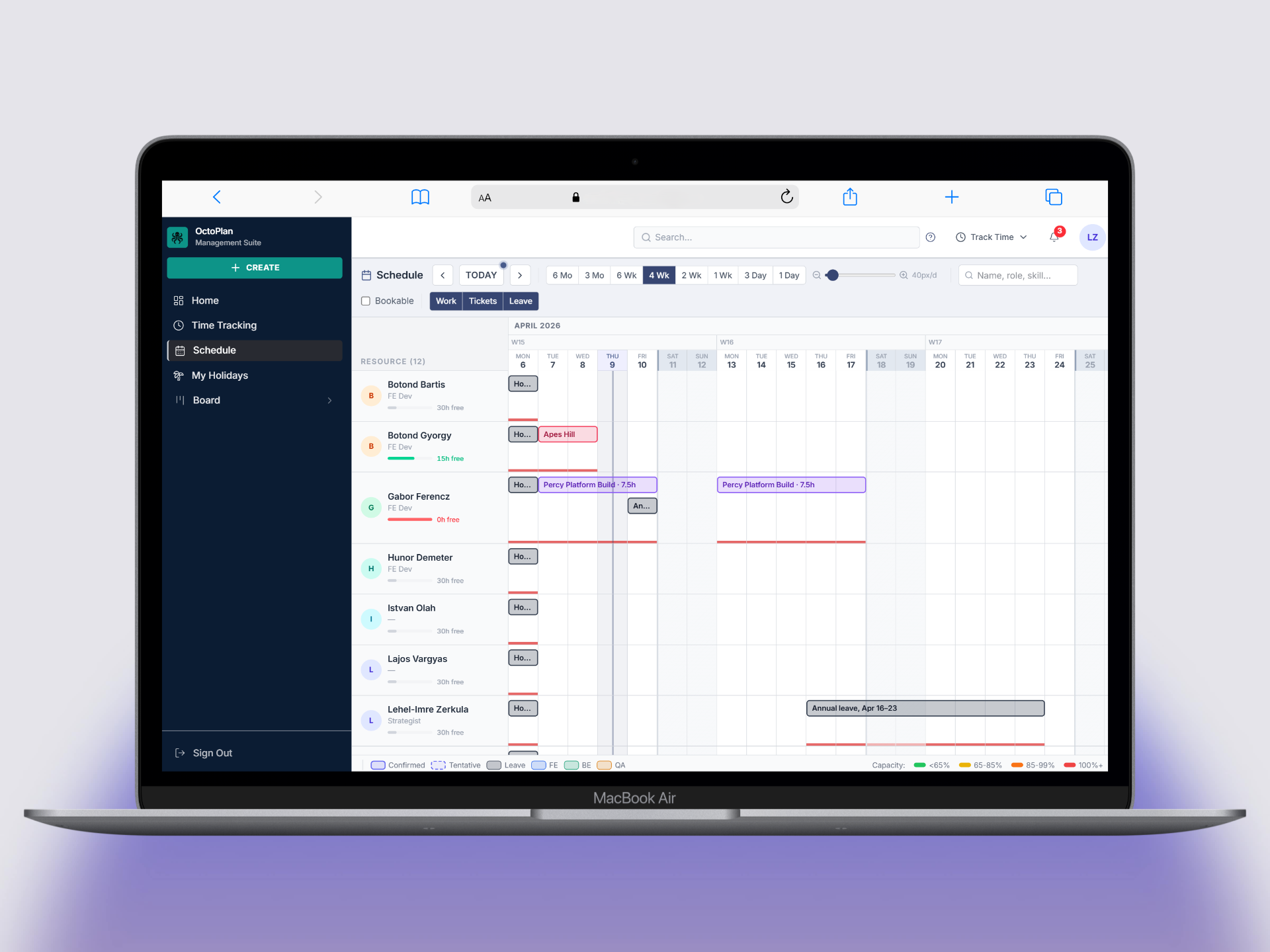
Built in three weeks using Claude Code — a full internal planning and company management platform that replaced five separate SaaS tools, with AI-powered ticket creation, intelligent forecasting, and deep migration from existing systems.
The Problem With Five Tools
Like most agencies, Octopus ran its operations across a stack of specialist tools: Resource Guru for resource scheduling, Everhour for time tracking, Asana for project and task management, a separate invoicing platform, and a holiday management system. Each did its job reasonably well in isolation. Together, they created a fragmentation problem.
Data lived in five places. A project manager who wanted to understand utilisation, upcoming capacity, and billable hours for the current sprint had to open multiple tabs and reconcile numbers manually. Forecasting was a spreadsheet exercise. Invoicing required exporting and re-entering data. Holiday approvals were disconnected from the resource calendar. The overhead was real, and it scaled with team size.
We decided to build the tool we actually needed — one that unified all of these functions into a single, integrated platform with intelligence built in.
What Octoplan Does
Dictation-based ticket creation. Engineers and project managers can create detailed, well-structured tickets by speaking rather than typing. Octoplan's AI layer transcribes the dictation, extracts the task details, applies the correct project and priority context, and creates the ticket with description, estimates, and assignee suggestions — ready for review and confirmation. The quality of AI-drafted tickets is consistently higher than hurriedly typed ones, and the friction of ticket creation drops significantly.
Estimation workflows. Structured estimation is built into the task workflow. When a ticket is created, the estimation process is guided and recorded — no more estimates living in Slack threads or email chains. Historical velocity data feeds back into the estimation interface so that the team can see how past estimates compared to actuals for similar task types.
Scheduling and resource management. Resource scheduling replaces Resource Guru: project assignments, capacity planning, and utilisation visibility are all in the same system as the tasks being scheduled. When a new project is scoped and tasks are created, the resource impact is visible immediately — no separate tool, no reconciliation.
Holiday and absence management. Holiday requests, approvals, and team-level absence visibility are integrated directly with the resource calendar. A holiday approval automatically updates capacity; a bank holiday in a specific region adjusts planning automatically.
Custom client access. Clients can be given scoped access to their project's progress, ticket status, and delivery timeline — without seeing internal cost data, team capacity, or other clients' work. Client-facing views are purpose-built for clarity rather than being filtered versions of the internal interface.
Intelligent forecasting and utilisation reporting. Octoplan forecasts revenue, utilisation, and capacity based on current project commitments, pipeline estimates, and team availability. The reporting layer surfaces the metrics that matter for agency operations: billable utilisation by person, project margin by client, forecast accuracy over time, and upcoming capacity gaps before they become delivery problems.
Invoicing. Invoices are generated directly from tracked time and project milestones — no data export, no re-entry. The invoicing module is connected to project and time data so that what is billed always matches what was delivered.
Deep migration from existing systems. We built migration tooling to move historical data from Asana, Everhour, Resource Guru, and the previous invoicing platform into Octoplan — preserving project history, time records, and client data so that the transition did not require a clean break from the past.
How We Built It: Three Weeks with Claude Code
Octoplan was built in three weeks. The speed was possible because of how we used AI throughout the build — specifically Claude Code, Anthropic's AI coding environment.
The architecture and data model were designed by the senior engineering team. The domain decisions — how tasks relate to projects, how utilisation is calculated, what the estimation workflow should feel like, how client access should be scoped — were made by humans. Then Claude Code was used aggressively for:
• Component and service scaffolding — generating the initial structure of each module from the design spec
• Data model implementation — translating the entity design into schema definitions, migrations, and typed API contracts
• Integration plumbing — the connectors for dictation processing, the migration importers, and the invoicing data pipeline
• Test generation — unit and integration test scaffolds for the core workflow and forecasting logic
Claude Code did not make architectural decisions or write the business logic for the forecasting engine. What it did was remove the gap between a design decision and a working implementation — turning days of scaffolding and wiring into hours, and allowing the team's attention to remain on the parts that required judgment.
The Outcome
Octoplan replaced Resource Guru, Everhour, Asana, the holiday management tool, and the invoicing platform — five separate SaaS subscriptions — with a single system purpose-built for how Octopus actually works.
The practical results were immediate: project managers have a single place for capacity, tasks, and delivery status. Invoicing is no longer a manual reconciliation exercise. Client access is handled without sharing internal tooling. Forecasting is based on live data rather than monthly spreadsheet updates.
Octoplan is now the operational backbone of Octopus's project delivery — and a demonstration that the same approach we use for clients, AI-augmented delivery with human architectural judgment, applies equally well to internal tooling.
From the journal

AI & Technology · 17 April 2026
Everyone's Building Tools With Claude. The Hard Part Is Shipping Them.

Development · 17 April 2026
Umbraco vs WordPress: Why Serious Businesses Are Making the Switch
AI & Technology · 17 April 2026
Umbraco 17 Is Here — And It Changes How You Work
What we do
SaaS.
Speed.
AI.
We are a boutique digital agency specializing in AI-powered development, high-end hospitality websites, and transformative technology solutions.