
The Hospitality Industry's Digital Reckoning
OTAs now take 15–25% of every booking they generate. Most hotel websites are built to exist, not to convert. Here is what the operators winning direct bookings understand — and what everyone else is missing.

Online travel agencies now take between 15 and 25 percent of every booking they generate. For a 50-room boutique hotel averaging £250 a night, that is somewhere between £680,000 and £1.1 million a year flowing out of the business to a platform that did not build the property, hire the staff, or deliver a single night's stay. And yet, for most operators, OTA dependency has grown every year for the past decade.
The reason is not that hotels lack ambition. It is that most hotel websites are not built to compete. They are built to exist — a digital presence that satisfies the requirement of having a website, rather than a commercial engine designed to acquire and convert guests directly.
That gap is now wide enough that closing it has become a genuine strategic priority for operators who want to control their own distribution economics.
The OTA Dependency Problem Is Getting More Expensive
Booking.com, Expedia, and Airbnb collectively processed over $150 billion in gross bookings in 2024. Their scale allows them to outspend almost any individual property on paid search, to offer guarantee programmes and flexible cancellation policies that hotels struggle to match individually, and to invest in UX and conversion optimisation at a level that no single hotel's website team can sustain.
The result is a structural disadvantage. A guest searching for a hotel in a specific city sees OTA listings above the hotel's own website in paid search. The OTA listing is faster, cleaner, and supports familiar payment methods. The hotel's site takes four seconds to load, its booking engine looks dated, and the rates are identical to the OTA — with no perceived reason to book direct.
57% of travellers visit a hotel's own website before booking through an OTA, according to research by Fuel Travel. They looked. The website failed to give them a reason to stay.
What the Highest-Converting Hotel Websites Do Differently
The properties winning direct bookings in 2026 are not winning because they have bigger budgets than OTAs. They are winning because they understand what a direct booking decision actually requires, and they engineer for it.
Speed is non-negotiable. Google's research shows that a 1-second delay in page load time reduces conversions by 7%. The average luxury hotel website weighs between 8 and 12MB, takes over 4 seconds to load on a typical mobile connection, and fails Core Web Vitals on Largest Contentful Paint. These are not aesthetic problems — they are direct booking losses measured in pounds per month.
The booking engine is the product. Most hotel websites treat the booking engine as a third-party widget bolted on at the end of the user journey. The best hotels treat the path from inspiration to reservation as the primary design problem. Every layout decision, every call-to-action placement, every piece of trust-building content exists in service of a frictionless booking conversion.
Photography is a performance variable, not just a creative one. High-resolution imagery is essential in luxury hospitality, but unoptimised images are the single largest contributor to slow load times. The solution is not to use worse photography — it is to implement next-generation formats, responsive images, lazy loading, and CDN delivery so that the photography works for conversions rather than against them.
Mobile is the primary booking device. 68% of luxury travel research now begins on a mobile device. Conversion rates on mobile are typically 2-3x lower than desktop on poorly optimised sites — not because mobile users do not want to book, but because the experience fails them. Properties that invest in mobile-first design close this gap substantially.
The Direct Booking Value Proposition
There are real incentives hotels can offer direct bookers that OTAs cannot match — best rate guarantees, room upgrade policies, early check-in priority, loyalty benefits, complimentary extras. But these incentives only convert if guests reach the hotel's own website and find a booking experience that gives them confidence.
The arithmetic is straightforward. If a property can shift 20% of its OTA-sourced bookings to direct, at an average saving of £40 per booking, on 5,000 annual bookings, the annual benefit is £40,000 — before accounting for the higher lifetime value of direct-booked guests and the data advantage of owning the customer relationship.
The website investment that enables this is a fraction of that number. Most luxury hotels are leaving a significant, recoverable amount on the table because the commercial case for a properly engineered website has not been made clearly enough to the people who control the budget.
The Technology Gap in Most Hotel Operations
Beyond the guest-facing website, the back-of-house technology in most hospitality businesses has not kept pace with operational demands. Rota management is in spreadsheets. Inventory is tracked across disconnected systems. Tronc distributions are calculated manually, creating compliance exposure under the Employment (Allocation of Tips) Act 2023. Finance data is reconciled monthly rather than in real time.
The operators moving fastest are those who understand that digital investment in hospitality is not just a marketing question — it is an operational one. The properties that have addressed both the front-of-house digital experience and the back-office operational infrastructure are performing better on margin, staff retention, and guest satisfaction metrics than those who have addressed only one or neither.
Where the Reckoning Lands
The hospitality industry's digital reckoning is not a future event. It is happening now, and the gap between operators who treat technology as a strategic asset and those who treat it as a necessary cost is widening with every quarter.
The properties that will perform best over the next five years are the ones that make the connection between their digital estate and their commercial outcomes explicit — and invest accordingly. That means a website built for direct booking conversion, a back-office operational platform that gives real-time visibility, and a technology partner who understands the industry well enough to build both.
The charm and service that define great hospitality have not changed. The infrastructure that supports them has to.
Keep reading

AI & Technology · 17 April 2026
Everyone's Building Tools With Claude. The Hard Part Is Shipping Them.
Development · 17 April 2026
Umbraco vs WordPress: Why Serious Businesses Are Making the Switch
AI & Technology · 17 April 2026
Umbraco 17 Is Here — And It Changes How You Work
Also from our work
Eunoia
Eunoia – Praxismenedzsment terapeutáknak
Egy praxismenedzsment operációs rendszer pszichoterapeuták számára – amelyet azért fejlesztettünk, hogy csökkentse a terápiás munka adminisztratív terheit, így a szakemberek arra fordíthatják az idejüket, ami igazán számít.
View article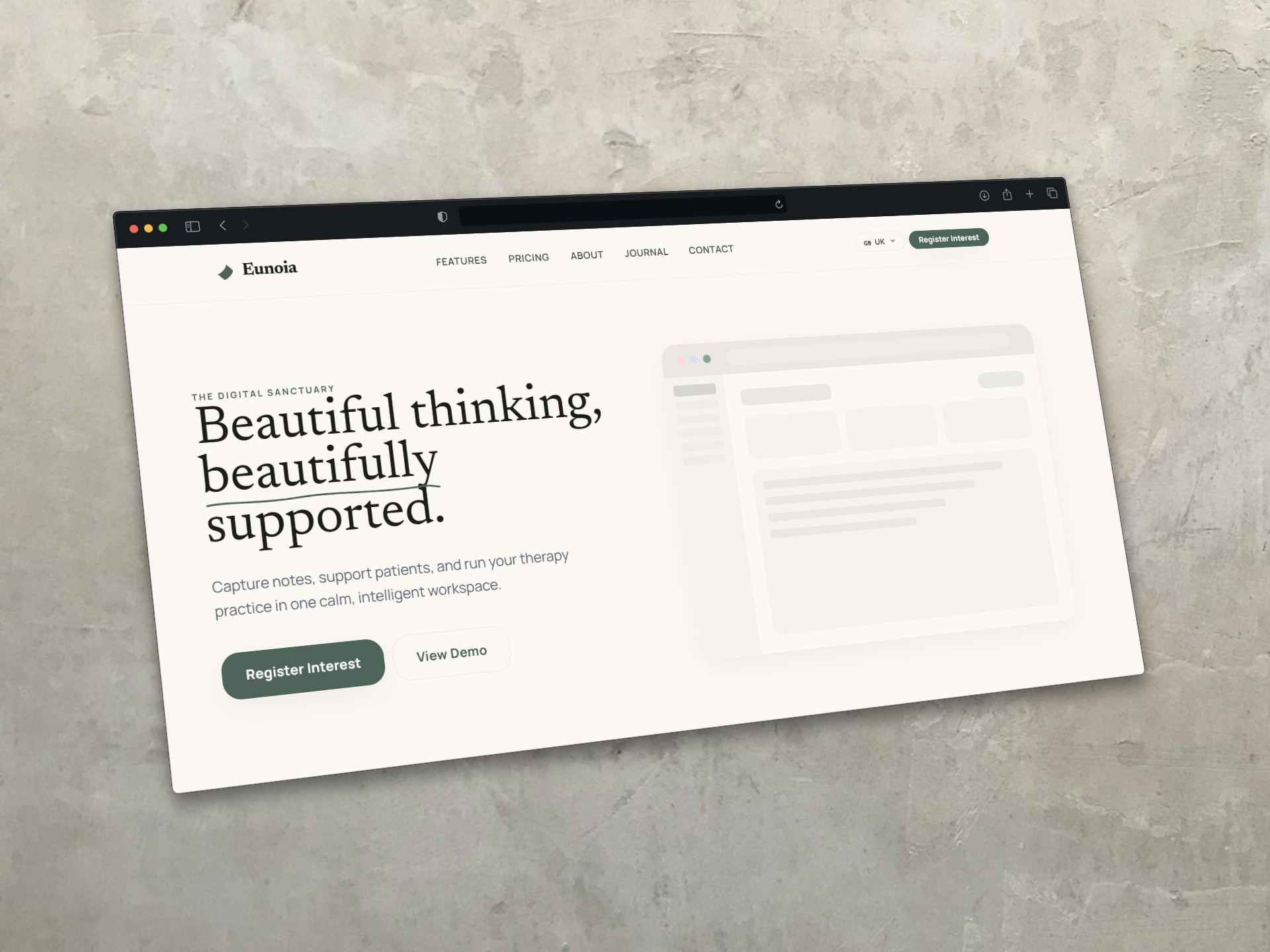
Keep Reading