
Designing for Luxury: The Principles Behind Our Hospitality Work
Luxury is one of the most misunderstood briefs in digital design. The difference between a site that looks expensive and one that performs in luxury contexts comes down to principles most agencies never articulate — here are ours.

Luxury is one of the most misunderstood briefs in digital design. Agencies unfamiliar with the sector interpret it as a visual style — dark backgrounds, serif typography, gold accents, expansive whitespace — and apply those elements like a costume. The result looks expensive until a real luxury guest lands on it, at which point it reads immediately as a simulation of luxury rather than the genuine article.
The difference between a luxury digital experience and a design that performs in luxury contexts comes down to something more fundamental: understanding what affluent, experience-led guests actually need from a website, and designing every decision around that understanding rather than around aesthetic convention.
After years of building digital products for high-end hospitality brands — properties where the average nightly rate is measured in hundreds of pounds and the guests have stayed at the finest hotels on four continents — these are the principles we have found to matter most.
Restraint Is Not Minimalism
The most common mistake in luxury design is conflating restraint with minimalism. Minimalism is an aesthetic movement with defined characteristics. Restraint is a discipline: the commitment to include only what earns its place and to remove everything that does not.
A restrained design may be rich in detail — a precisely crafted typeface at a large scale, a full-bleed photograph with considered cropping, a subtle texture in the background — while a minimalist design may feel cold and impersonal. Luxury guests are not looking for sparse interfaces; they are looking for considered ones.
In practice, restraint means resisting the temptation to explain too much. Luxury brands do not justify their prices; they demonstrate their quality through the confidence of their presentation. A hotel website that leads with long paragraphs of marketing copy is not a luxury experience. One that leads with a single, extraordinary image and a clear invitation to explore communicates quality in a way that copy cannot.
Performance Is Part of the Experience
No luxury experience begins with waiting. A guest arriving at a five-star property does not expect to queue for check-in. A guest arriving at a five-star website should not wait four seconds for content to appear.
Google's research shows a 1-second delay in page load reduces conversions by 7%. For a luxury hotel website where the average booking value might be £1,500–£3,000, that is a meaningful commercial loss per percentage point of abandoned visitors. More importantly, a slow website communicates the wrong thing: that this property does not attend to detail.
We engineer for performance from the first design decision. Image format choices, lazy loading strategies, font loading behaviour, and JavaScript bundle size are not afterthoughts addressed in a technical QA pass — they are design constraints we work within throughout the project. A site that achieves an LCP under 2 seconds with full-resolution editorial photography is a solved problem; it just requires building performance into the process rather than optimising for it at the end.
Core Web Vitals also affect organic search rankings directly. A luxury property competing for high-intent search terms — 'boutique hotel Cotswolds', 'luxury spa hotel Yorkshire' — is giving ground to competitors with faster sites if performance is not addressed. The aesthetic and the commercial case point in the same direction.
Photography Leads; Design Supports
In hospitality, the product is an experience, and experiences cannot be fully communicated in words. Photography is the primary medium through which a potential guest forms the emotional connection that precedes a booking decision. The design's job is to give that photography maximum impact — not to compete with it.
This shapes fundamental layout decisions. We design hospitality websites around the photography rather than fitting photography into a pre-designed layout. Aspect ratios, focal point placements, colour palette derivation, and typographic contrast are all informed by the specific imagery the property produces. Generic templates cannot do this; every luxury hospitality build requires this level of attention to the relationship between design and content.
Editorial photography for luxury properties typically runs to 80–120 hero images per project. Managing that volume of high-resolution content — ensuring it loads fast, displays correctly across every viewport, and can be updated without developer intervention — requires both technical architecture and a content management system designed for the task.
The Booking Flow Is the Product
Everything on a luxury hospitality website exists to serve a single goal: the booking. Brand story, photography, amenity descriptions, location pages, and sustainability commitments all have their place — but they are instruments in service of the moment when a guest decides to reserve.
The booking flow deserves more design attention than it typically receives. Most hotel websites treat the booking engine as a necessary utility, handed off to a third-party widget with default styling and generic UX. In reality, the booking flow is where the luxury experience either holds together or collapses. A beautiful, considered homepage followed by a cluttered, confusing reservation interface is not a luxury experience — it is a luxury first impression followed by a disappointing one.
We design the booking flow with the same care as the marketing pages: clear rate presentation, logical date and room selection, transparent pricing with no surprise fees at checkout, and trust signals (reviews, guarantee statements, cancellation policies) placed at exactly the moments in the flow when hesitation is most likely to occur.
Internationalisation Without Dilution
Luxury hospitality operates globally. A property in the Cotswolds draws guests from North America, the Gulf, Southeast Asia, and across Europe. Serving those audiences in their own language is an expectation, not a bonus — but internationalisation done poorly dilutes the brand rather than extending it.
Machine-translated content reads as machine-translated content. A luxury brand that has invested in a refined English-language voice and then serves German-speaking guests a literal translation of that copy is communicating, subtly but clearly, that those guests are a secondary consideration. We approach multilingual hospitality builds with localisation rather than translation — adapting the brand voice for each market while maintaining the tone and quality that define the property's identity.
The technical architecture for internationalised sites also requires care: hreflang implementation, locale-specific URL structures, and CMS workflows that make it possible for non-technical content teams to manage multiple languages without developer involvement.
Motion Is Felt, Not Seen
Animation in luxury design is one of the most easily abused tools available. Brands that have seen competitors use parallax effects or fade-in transitions often add motion to their own sites without asking what it is for — and the result is movement that draws attention to itself rather than enhancing the experience.
Motion in luxury hospitality should reinforce the sense of care and craft: a header image that loads with a considered reveal rather than a jarring pop-in, a navigation transition that feels unhurried, a page scroll that breathes rather than rushes. When executed well, visitors do not notice the animation — they simply feel that the website is refined. When executed poorly, they notice it immediately, and what they notice is that it feels gratuitous.
We use motion sparingly and always in service of the experience. Every animated element in our hospitality builds has a specific reason to exist — it is not decoration.
The Standard We Hold Ourselves To
The test we apply to every hospitality website before it goes live is simple: would a guest who has stayed at the best hotels in the world find this experience consistent with that standard? Not in the sense of replicating a hotel lobby experience on a screen — that is not what digital does — but in the sense of attention to detail, absence of friction, and confidence in presentation.
That standard is harder to achieve than it sounds. It requires saying no to things that feel reasonable in isolation but do not meet the bar. It requires pushing back on content that is competent but not excellent. It requires understanding the guest's perspective well enough to recognise when a design decision that satisfies a stakeholder does not satisfy the person who will ultimately make the booking decision.
It is the standard our hospitality clients come to us for. It is the one we are unwilling to compromise on.
Keep reading

AI & Technology · 17 April 2026
Everyone's Building Tools With Claude. The Hard Part Is Shipping Them.
Development · 17 April 2026
Umbraco vs WordPress: Why Serious Businesses Are Making the Switch
AI & Technology · 17 April 2026
Umbraco 17 Is Here — And It Changes How You Work
Also from our work
Eunoia
Eunoia – Praxismenedzsment terapeutáknak
Egy praxismenedzsment operációs rendszer pszichoterapeuták számára – amelyet azért fejlesztettünk, hogy csökkentse a terápiás munka adminisztratív terheit, így a szakemberek arra fordíthatják az idejüket, ami igazán számít.
View article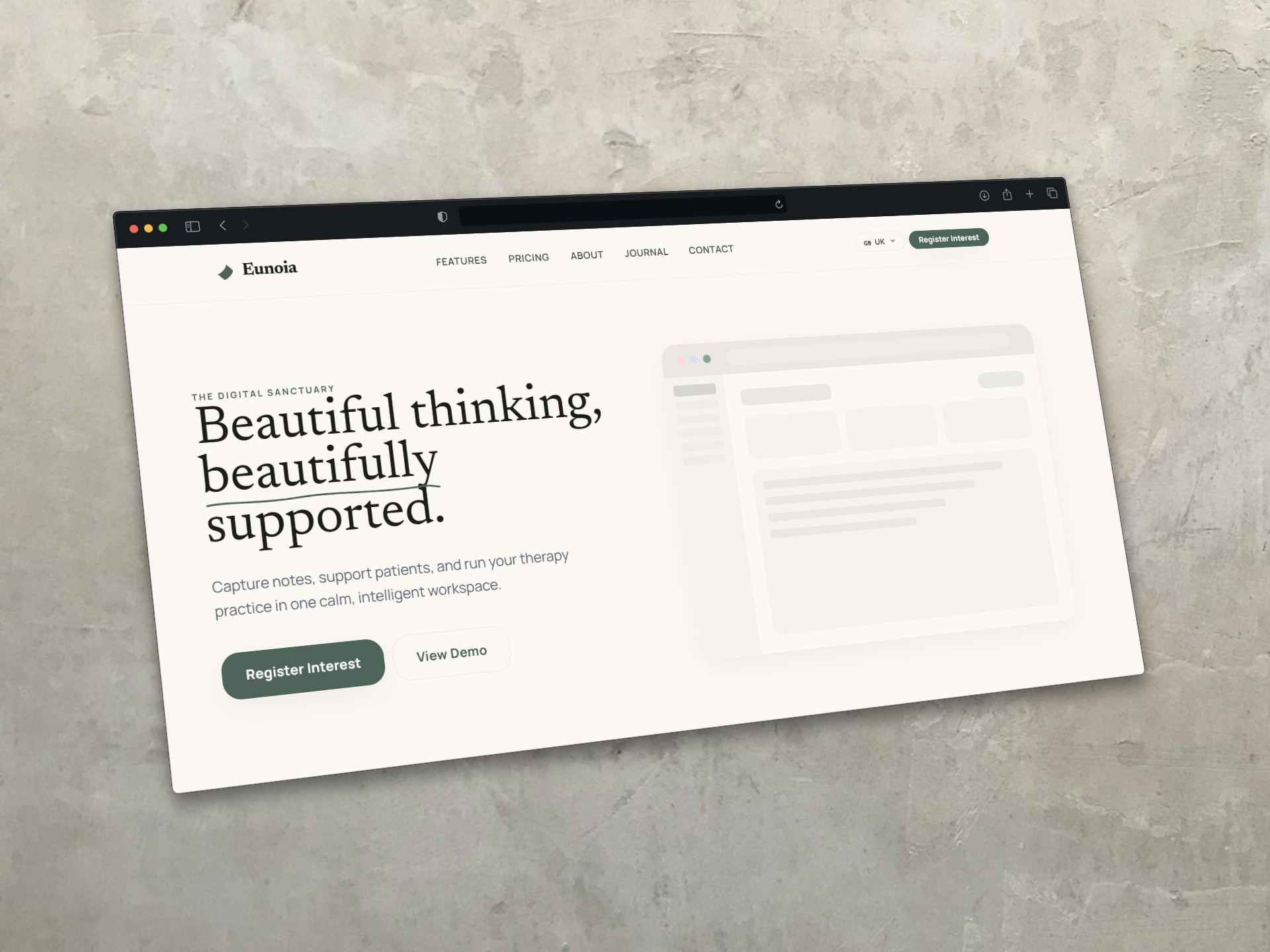
Keep Reading