
Building AI-Powered Search and Recommendation for SaaS Products: A Practical Architecture Guide
AI-powered search drives 35% higher conversion than keyword search. Recommendation engines account for 31% of Amazon's revenue. Building this into your SaaS product is now a competitive expectation, not a differentiator.

Users who were impressed by autocomplete in 2018 now expect semantic search as standard. When someone types a half-remembered phrase into a search box and your product returns nothing, they do not conclude that the content does not exist. They conclude that your search is broken. And in 2026, a broken search is a competitive disadvantage in any SaaS product where users need to find things.
The gap between keyword search and AI-powered search is not subtle. Keyword search matches terms. Semantic search understands intent. A user searching for 'what to do when a team member is underperforming' in a keyword-indexed HR platform gets zero results or a list of articles with those exact words. In a semantically indexed platform, they get the performance management documentation, the difficult conversations guide, and the PIP template.
The Technical Architecture
Semantic search and recommendation systems share the same foundational layer: vector embeddings. Every piece of content — document, product, article, support ticket — is converted into a high-dimensional vector representation by an embedding model. These vectors encode semantic meaning: content that discusses similar concepts has similar vectors, regardless of whether it shares specific keywords.
At query time, the user's search query is embedded using the same model, and the vector database returns the content whose embeddings are closest to the query embedding. The results are semantically relevant rather than lexically matched.
Vector databases purpose-built for this workload — Pinecone, Weaviate, Qdrant — handle billion-scale embedding retrieval in milliseconds. For most SaaS products at startup and growth stage, the engineering challenge is not the retrieval infrastructure but the embedding pipeline: keeping the index fresh as content is added, updated, and deleted, and choosing the right embedding model for the specific content domain.
Recommendation Architecture
Recommendation engines are a different architecture from search but often sit on the same vector infrastructure. Collaborative filtering — 'users who did X also did Y' — requires user behaviour data at sufficient volume to be reliable. Content-based filtering — 'this item is similar to items you engaged with' — can work with much smaller datasets and is typically the right starting point for early-stage SaaS products.
For SaaS products in the early growth phase, we implement content-based recommendation using the same vector embeddings as the search layer: surface content similar to what the user has recently interacted with, filtered by their role, permissions, and usage context. This provides useful recommendations from day one without requiring the behaviour volume that collaborative filtering needs.
35% higher conversion on AI-powered search vs keyword search is documented across multiple enterprise SaaS studies. The mechanism is straightforward: users who find what they are looking for on the first attempt engage more, return more, and churn less.
Implementation Patterns That Work
The most common mistake in AI search implementation is treating it as a search infrastructure project rather than a product project. The embedding model, indexing pipeline, and retrieval layer are table stakes — the value comes from the search experience built on top: query understanding that disambiguates short queries, faceting and filtering that lets users narrow results without retyping, result ranking that accounts for recency, quality, and user context alongside semantic similarity.
We build search and recommendation features as first-class product components, with the same design and UX attention as the core product flows. The infrastructure layer is well-solved by existing tooling. The product layer — how search results are presented, how recommendations are explained, how the system handles no-results cases — is where the user experience actually lives.
Keep reading

AI & Technology · 17 April 2026
Everyone's Building Tools With Claude. The Hard Part Is Shipping Them.
Development · 17 April 2026
Umbraco vs WordPress: Why Serious Businesses Are Making the Switch
AI & Technology · 17 April 2026
Umbraco 17 Is Here — And It Changes How You Work
Also from our work
Eunoia
Eunoia – Praxismenedzsment terapeutáknak
Egy praxismenedzsment operációs rendszer pszichoterapeuták számára – amelyet azért fejlesztettünk, hogy csökkentse a terápiás munka adminisztratív terheit, így a szakemberek arra fordíthatják az idejüket, ami igazán számít.
View article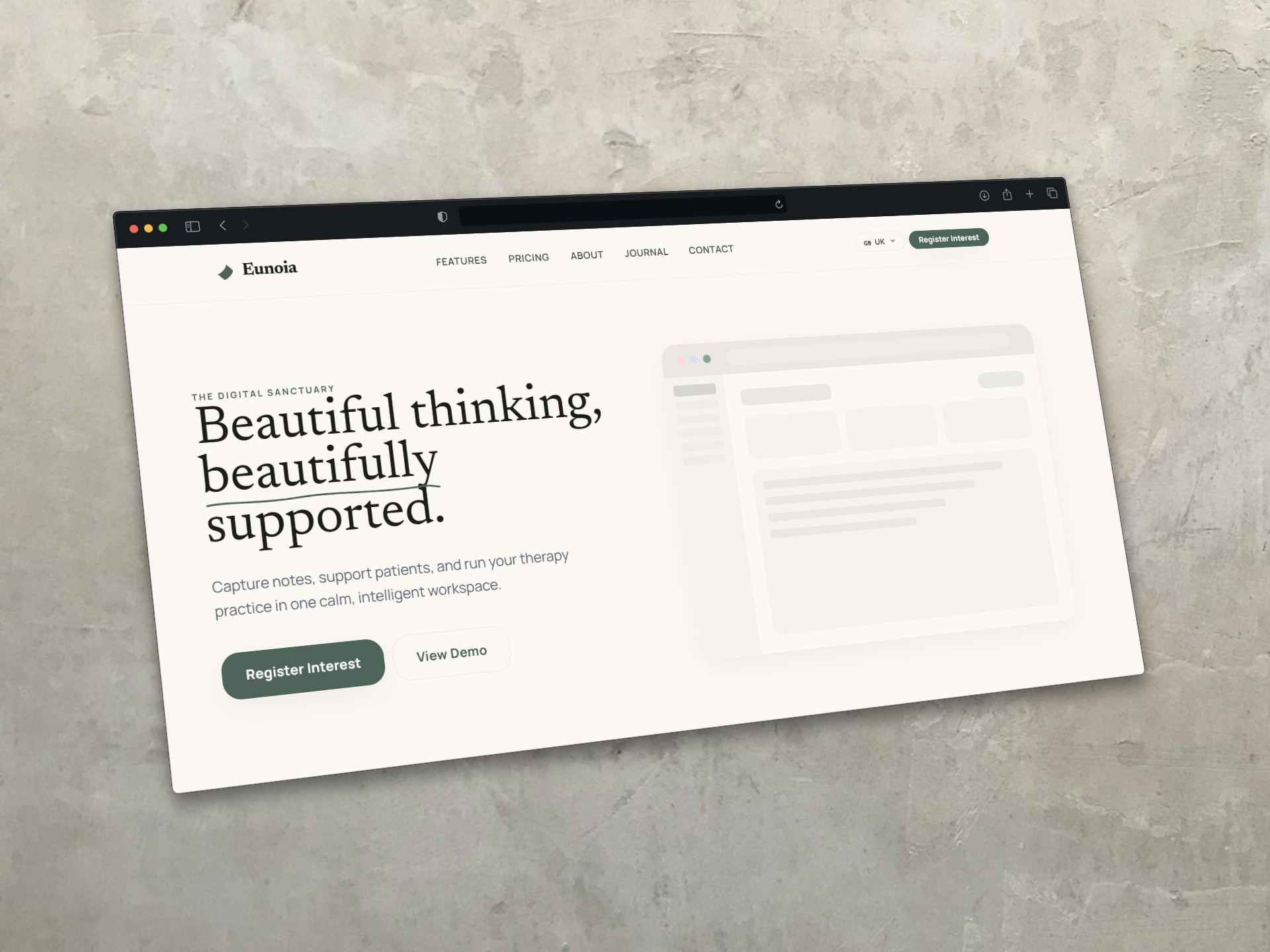
Keep Reading